8 min read ResuFit Team
How AI Screens Your Resume Before a Human Reads It
Job Application Materials Resume & CV Tools
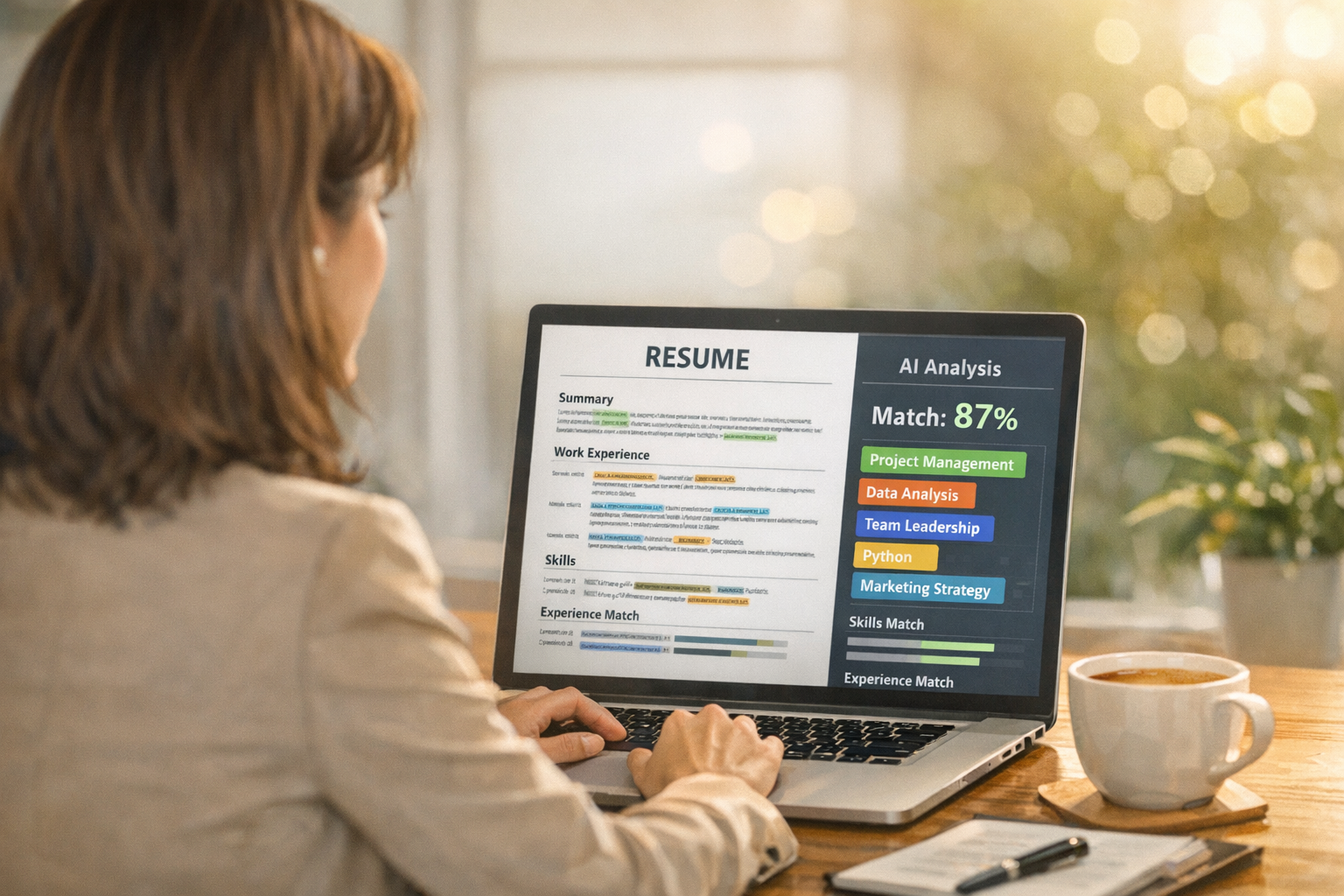
Picture this: you hit submit on a job application, and the first decision about your future is made by an algorithm. No gut feeling, no sympathy, no “interesting career path.” Just code.
This isn’t a future scenario. It’s the current reality. In 2026, 52% of talent acquisition leaders plan to integrate AI agents into their recruiting workflows, with systems capable of handling up to 80% of all screening activity. If you’re still writing resumes for human eyes only, you’re already behind.
Here’s exactly what happens to your resume the moment it lands in a company’s inbox, and how to ensure it makes it through.
Applicant Tracking Systems (ATS) have existed since the 1990s. The original version was simple: parse the document, hunt for keywords, assign a score. Many job seekers already know this game and have adapted.
What’s different now: modern systems aren’t keyword matchers anymore. They use Large Language Models (LLMs) and semantic analysis to understand meaning, not just exact strings. The system knows that “project management” and “program oversight” are related. It recognizes whether your bullet points describe tasks or demonstrate impact. It can infer whether your career trajectory makes sense for the role.
Beyond screening, the new generation of AI agents takes on work that humans used to do:
The bottom line: a human may not see your resume until it already has an AI-generated score next to it.
Before any evaluation happens, the system must read your resume. It extracts raw text and maps it to categories: contact info, work experience, education, skills, certifications.
This is where many applications die quietly. Tables, text boxes, graphics, multi-column layouts, and headers/footers all break parsers. Your carefully designed infographic reads as gibberish, or gets skipped entirely. Even contact information placed in a document header is often missed.
Format for machines first. Design for humans second.
Modern systems compare your resume to the job description using semantic similarity, but exact keyword matches still score higher in most implementations. If the posting says “Agile project management,” write those exact words. Don’t assume “Scrum experience” is equivalent in the system’s eyes.
The job description is effectively the answer key. Use it.
The system generates a match score, typically weighted across these factors:
| Factor | Weight |
|---|---|
| Keyword match | High |
| Quantified achievements | Medium–High |
| Career continuity | Medium |
| Formal qualifications | Medium |
| Document formatting quality | Low–Medium |
This score determines whether your resume lands on a recruiter’s screen, or sits in a low-priority queue.
Sufficient score isn’t enough. Every applicant with a passing score gets ranked, and recruiters typically see only the top results. At high-volume companies, the difference between rank 3 and rank 15 can be the difference between an interview and silence.
Candidates who back their accomplishments with concrete numbers see a 40% higher response rate, according to multiple hiring studies. The reason: AI systems flag measurable results as quality signals.
Weak: “Responsible for optimizing internal processes” Strong: “Reduced procurement cycle time by 34% through vendor consolidation, saving $180K annually”
For every bullet point, ask: How much? How many? Over what time period? What was the impact?
A complete guide to resume keywords for ATS success covers this in depth. Here’s the short version:
Work through the job posting systematically:
Keyword stuffing is detected. Modern systems recognize unnatural repetition and can penalize or flag applications for manipulation.
AI systems evaluate whether your trajectory makes sense for the target role. Gaps, frequent short tenures, or seemingly unrelated experience are flagged as risk factors, unless you contextualize them. Freelance work, continuing education, and parental leave should appear as full entries, not blank space.
Section headers like “Work Experience,” “Education,” and “Skills” help parsers map your resume correctly. Creative alternatives like “My Journey” or “What I Bring” confuse the system. This isn’t the place to stand out.
Step 1: Analyze the job posting: Copy the full text and highlight every skill, tool, qualification, and requirement mentioned. Note repetitions.
Step 2: Audit your resume: Identify which highlighted terms are absent from your resume or buried in synonym form.
Step 3: Rewrite bullet points: Replace task descriptions with result statements. Add numbers wherever you can find them.
Step 4: Check your format: Single column, standard font (Arial or Calibri, 11pt), no tables for content, no graphics. Save as PDF from a word processor, not scanned.
Step 5: Test before submitting: Tools like ResuFit automatically analyze your resume against a specific job description, identifying keyword gaps and suggesting concrete improvements before you apply.
Here’s the crucial context: AI screening is the first gate, not the whole process. Despite all the automation, 73% of talent acquisition leaders say their top hiring priority is critical thinking and problem-solving. AI skills rank fifth.
What algorithms consistently fail to assess:
Optimization gets you in the door. Your personality closes the deal.
One important data point: 66% of US adults say they would avoid applying to jobs that use AI in hiring, and only 26% of candidates trust AI to evaluate them fairly.
That skepticism is understandable. But these systems are already in place at the majority of large employers, whether disclosed or not. The pragmatic response isn’t avoidance. It’s preparation.
Understanding how these systems work lets you work with them, not against them, without sacrificing what makes you a compelling candidate.
AI resume screening is standard practice in 2026. The good news: these systems follow predictable rules. Resumes that combine measurable achievements, precise keywords, and clean formatting consistently perform better.
ResuFit handles the analysis for you: upload your resume and a job description, and get specific optimization recommendations in seconds, built for both AI systems and the human recruiters who see you next.
How is AI screening different from classic ATS? Classic ATS scanned for exact keyword matches. Modern AI systems use semantic analysis and understand context, but they still depend on machine-readable, well-structured documents.
Should I tailor my resume for every application? Yes. Keyword alignment to each specific posting is the single most effective way to improve your AI score. ResuFit automates most of this work.
Does a longer resume hurt my AI score? AI systems don’t penalize length. More relevant context can actually help. For human readers, aim for one to two pages for most roles. Two pages is widely accepted in the US and UK for experienced candidates.
How do I know if a company uses AI screening? Most companies don’t disclose this. Assume any application going through an online portal at a mid-size or large company is screened automatically. Optimize as a default.
Can I game the system with keyword stuffing? Short-term, maybe. Modern systems detect unnatural repetition and can flag your application. More importantly, a human will see your resume eventually, and stuffed text is immediately obvious. Use keywords naturally within meaningful bullet points.
Get the latest tips on resume writing and career advice.